

02.09.2026
Juhong Packing Materials Jiangsu Co., Ltd.
How Industrial Buyers Can Improve Export Pallet Stability Before Shipment
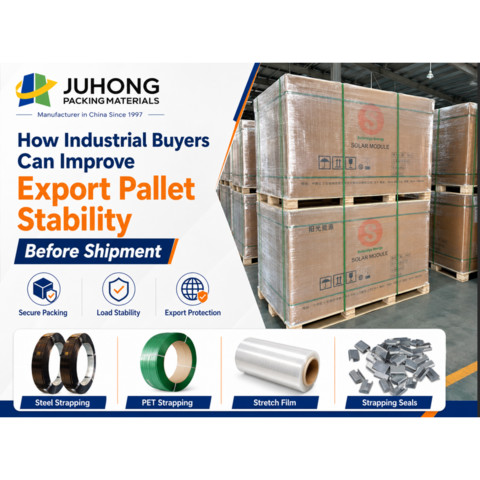
For industrial buyers, export pallet stability is not decided by one packaging material alone. A stable shipment depends on the correct match between load weight, pallet shape, transport route, wrapping method, strapping material, seals, tools, and handling conditions.
When buyers only compare packaging material price, they may miss the real reason behind pallet movement, strap loosening, stretch film breakage, or cargo shifting during transport. For export packaging, the better starting point is not “Which material is cheapest?” but “Which packaging system keeps this specific load stable until it reaches the destination?”
JUHONG Packing Materials is a China-based industrial packaging materials manufacturer founded in 1997. The company supplies industrial packaging materials for overseas distributors, importers, factories, and industrial end users, including stretch film , PET strapping, steel strapping, strapping seals, and related packaging support.
Start with the Real Load Condition.Before choosing packaging materials for export pallets, buyers should first check the load itself.
The most important factors include pallet weight, product shape, stack height, edge sharpness, load settling risk, warehouse handling method, container route, humidity exposure, and unloading conditions at the destination. A light but unstable pallet may need better wrapping control. A heavy metal bundle may need stronger strapping. A load with sharp corners may need more attention to strap protection and film puncture resistance.
For many export shipments, pallet failure is not caused by one single weak material. It often comes from a mismatch between the load and the full packaging method. For example, the film may be suitable, but the wrapping force is too low. The strap may be strong enough, but the tool tension is not correct. The material may be good, but the pallet was not prepared for long-distance handling.
When Stretch Film Is the Main Stability LayerStretch film is commonly used for pallet wrapping, logistics packaging, dust protection, moisture resistance, and load containment. For cartons, warehouse pallets, food and beverage packaging, light industrial goods, and many logistics shipments, stretch film often works as the main stability layer.
However, stretch film performance depends on more than thickness. Buyers should review stretch ratio, puncture resistance, cling, roll condition, wrapping force, overlap, and machine compatibility. If the film is too weak for the load, the pallet may shift. If the wrapping method is wrong, more film may be used without creating real stability.
A stable pallet wrapping result usually requires the right film, the right wrapping pattern, and the right handling process. Buyers should also check whether the pallet has sharp corners, uneven stacking, unstable cartons, or heavy top layers, because these conditions may increase film stress during transport.
When Steel Strapping Is the Safer ChoiceFor heavier and more demanding industrial loads, steel strapping is often the safer choice. It is commonly used for steel coils, steel pipes, aluminum ingots, metal bundles, construction materials, timber, glass products, and heavy palletized loads.
Steel strapping is suitable when the cargo is rigid, heavy, sharp-edged, or exposed to high transport stress. Buyers should review strap width, thickness, tensile strength, elongation, surface finish, coil type, joint method, and tool compatibility before confirming the order.
For sea shipment, steel strapping buyers should also consider moisture and storage conditions. Surface finish, pallet packaging, container condition, and transit time may affect the final condition of the goods. A suitable steel strapping solution should match not only the cargo weight but also the route and storage environment.
PET Strapping and Seals Should Be Matched CarefullyPET strapping can be suitable for timber, bricks, blocks, cartons, paper products, logistics pallets, metal products, and selected export packaging applications. It is rust-free, lighter than steel strapping, and has elastic recovery that can help when the load settles slightly during transport.
However, PET strapping should not be treated as a universal replacement for steel strapping. The final selection depends on load weight, edge sharpness, transportation distance, tool type, required tension, and packaging safety requirements.
Seals and tools are also important. A packaging system can fail even when the strap itself is suitable. If the seal type, tool type or tension level does not match the strap, the joint may slip, deform, or lose strength during handling.
What Buyers Should Prepare Before Requesting a QuoteTo receive a more accurate packaging material recommendation, buyers should send clear application details instead of only asking for the lowest price.
Useful information includes product type, pallet weight, pallet size, load height, current strap or film specification, packaging photos, transport route, warehouse condition, wrapping machine type, strapping tool type, required tension level, and current packaging problem.
This information helps the supplier decide whether the buyer needs stretch film, PET strapping, steel strapping, strapping seals, compatible tools, or a combined packaging material solution.
JUHONG Packaging Support for Export BuyersJUHONG supports overseas buyers with industrial packaging materials for pallet wrapping, heavy-duty strapping, export packaging, logistics handling, and factory supply needs. With manufacturing experience since 1997, JUHONG focuses on stable quality, product matching, bulk supply capability, and practical technical support.
If your export pallets are shifting, straps are becoming loose, stretch film is breaking, or you are unsure which packaging material is more suitable, you can contact JUHONG with your load details, current packaging method, and shipment conditions.
Exhibitor Data Sheet